



Alien Invaders
Invasive Plants
Native plants are fighting a battle for survival. Some combatants are easily recognized…the bulldozer plowing down natural habitat…the industrious gardener poisoning “that patch of weeds” where their property meets the local meadow… Others are more pernicious. Alien invasive plants have been steadily infiltrating North America for hundreds of years, arriving with settlers, imported by garden centers, escaping from our gardens…
Some are relatively innocuous…merely occupying space more usefully filled by native species. A very few even fill a small role in local ecosystems. The nectar of Queen Anne’s lace, for example, is enjoyed by Swallowtail butterflies and dandelions provide flowers for early spring pollinators to feed on.
Many more, however, not only play no part in ecosystems, they out-compete native species to create monocultural deserts. Phytochemicals secreted by some species actually inhibit the growth of tree seedlings and other plants.
How can you help?
- Learn about invasive species by reading or visiting websites devoted to the subject (we have listed a few below). The Invasive Species Centre is a good start!
- Report sightings of invasive species. Find the reporting system in your area here.
- Join a restoration effort in your area to weed out invasive plants
- Remove them from your own properties. Download Best Management Practices guides for advice on how to do this
- Ask local nurseries to stop selling them. Take your Grow Me Instead guide when you are plant shopping!
- Contact your Provincial Member of Parliament or State Legislator and municipal Councillor to find out if there is legislation to halt the sale and propagation of these plants…and if not, demand that they do so! In Ontario the Invasive Species Act was passed in 2016. Learn more about it here.
Norway Maple
Acer platanoides
Name:
Although it is called “Norway” maple, it is actually indigenous to much of eastern Europe and down to the Caucasus. The species Latin name, meaning “like Platanus,” indicates the similarity of the leaves to those of Sycamore and Planetree, to which it is not related.
Identification:
Norway Maple is a fast-growing maple which can become 30m (100 feet) tall. It has been widely planted as a street and shade tree due to its vigorous growth and tolerance of poor soil, compaction and pollution.
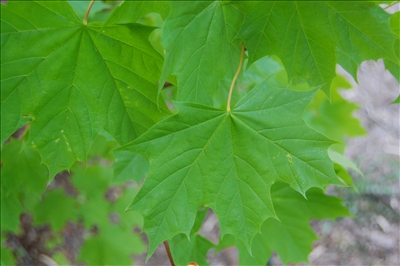
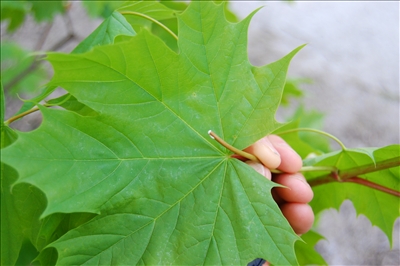
At first glance it looks similar to a Sugar Maple (Acer saccharum), but the leaves are usually wider than they are long, and have more lobes than the Sugar Maple. Fortunately there is an easy way to identify the Norway Maple: Break off a leaf and look for the characteristic white sap which comes out of the leaf stalk.
Origin and Introduction:
Norway maple is prevalant in much of Europe from Norway and Sweden to the Caucasus Mountains, Turkey and Iran. It was originally introduced into North America by John Bartram who received seedlings from London in 1756. He went on to sell Norway maples from his nursery in Philadelphia. George Washington ordered two Norway maples from Bartram for his garden at Mount Vernon in 1772. When Dutch Elm Disease wiped out elms in cities across North America, the Norway maple was often planted as a reliable and rapidly growing replacement, which could withstand city pollution.
The problem:
The Norway maple produces large numbers of seeds, which are typical maple keys, but with the two wings at almost 180 degrees to each other. These seeds mature in September and are spread by the wind. They can germinate even in dense shade, and the seedlings grow quickly.
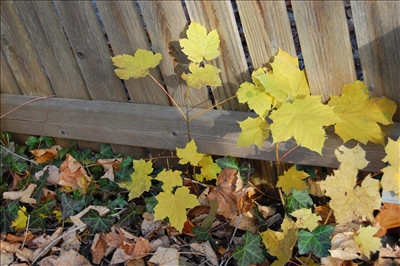
Norway Maples can out-compete other native trees. They leaf out earlier, and the leaves remain longer into the fall. They tolerate shade themselves, but create deep shade underneath where little else can grow. They suck up water, so that the soil underneath becomes dry. They may also be allopathic, producing chemicals which prevent native plants germinating. This sets the scene for soil erosion. A typical comment is that the tree looks healthy, but the ground underneath is a mess and needs work. However, it is almost impossible to grow anything in the shade of a Norway maple. In Toronto backyards some people have given up ad installed plastic turf for their children to play on!
Control Methods:
Smaller seedlings can be removed by hand, and saplings can be dug up. Larger trees may need to be felled by professionals. If girdling or cutting are used the tree must be treated to prevent resprouting. Removing a mature tree to prevent it being a seed source for nearby natural areas is desirable, but can be a major and expensive undertaking. In some cases all that may be possible is to remove some of the lower branches to allow more light through and to reduce seed production.
Restrictions on Use:
Some US States including New Hampshire and Massachusetts have banned Norway maples. It is considered invasive in CT, DC, DE, IL, MA, MD, ME, MI, NH, NJ, NY, OR, PA, TN, VA, VT, WI, and WV.
Availability and Alternatives:
Norway Maples are widely sold in nurseries, and many landscapers consider them to be reliable hardy shade trees which they recommend to clients. There are many commercial cultivars, such as the purple-leaved “Crimson King” and a variegated cultivar. Be careful requesting a “Red Maple” as an alternative to a Norway maple, as you may be sold the “Crimson King” version of Norway maple, which has dark red leaves, rather than red maple, Acer rubrum, which has green leaves.
Consider other maples such as red maple (Acer rubrum) – good fall colour, or sugar maple (Acer saccharum) – damaged by road salt. Also consider American basswood (Tilia americana), red oak (Quercus rubra), white ash (Fraxinus americana), tuliptree (Liriodendron tulipifera). In Southern states consider sweet gum (Liquidamber styraciflua), black gum (Nyssa sylvatica), and willow oak (Quercus phellos).
Conclusion:
The Norway Maple will continue to invade forests across the United States unless the spread is controlled. Because seedlings can survive in deep shade for decades, any attempt to eliminate the Norway Maple would have to be carefully monitored for over 100 years.”
University of Michigan
If nothing is done regarding the invasion of the Norway Maple we predict that in years to come there will be strong homogenizing of the Maples in forests across the United States. In extreme cases, this would lead to much more plant extinctions, and losses of compatible habitats for animals.”
University of Michigan
Periwinkle
(Vinca minor)
ID:
In an appropriate location, periwinkle is an attractive low-lying ground cover, with small dark green evergreen leaves and pretty pale blue flowers in spring. It tolerates shade and spreads slowly.


Introduction:
It was introduced to North America from Europe in the 1700’s.
Problem:
Common periwinkle poses a threat to native plants and communities because it grows vigorously, forming a dense evergreen ground cover that displaces and excludes most other plants, including native wildflowers. It spreads vegetatively in the immediate area, and is not spread by seeds.
The US Department of Agriculture Forest Service nominated periwinkle as a “Weed of the Week” and reported that it is invasive in the following American States: CA, CT, DC, DE, GA, IA, IL, IN,KY, MD, MI, NC, NJ, NY, OH, OR, PA, RI, SC, TN, TX, VA, WA, WI, and WV. In Canada it is mainly a concern if planted in rural properties where it has the opportunity to spread into woodlands.
Control:
Periwinkle can be removed by digging, raising the runners with a rake, and mowing the plants. All of the plant must be removed. It can also be controlled by cutting the plants in the spring followed by applying a herbicide to the regrowth.
Availability and Alternatives:
Widely available, including some variegated cultivars.
The US Invasive Plant Atlas Web site recommends many native alternatives, including:
Arctostaphylos uva-ursi (kinnikinnick)
Clinopodium douglasii (yerba buena)
Eurybia divaricata (white wood aster)
Euonymus obovatus (running strawberry bush)
Gelsemium sempervirens (evening trumpetflower)
Mahonia repens (creeping barberry)
Mitchella repens (partridgeberry)
Nemophila phacelioides (largeflower baby blue eyes)
Paxistima myrsinites (Oregon boxleaf)
Packera obovata (roundleaf ragwort)
Pachysandra procumbens (Allegheny-spurge)
Ruellia nudiflora (violet wild petunia)
Symphoricarpos mollis (creeping snowberry)
Vaccinium crassifolium (creeping blueberry)
Vaccinium elliottii (Elliott’s blueberry)
Waldsteinia fragarioides (Appalachian barren strawberry)
Autumn and Russian Olives
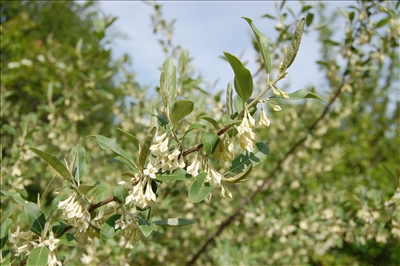
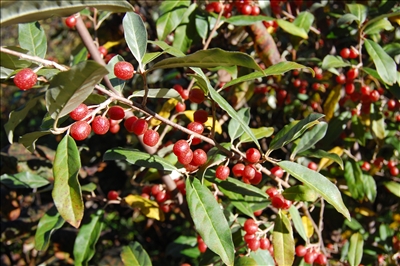
Elaeagnus umbellata and angustifolia
ID:
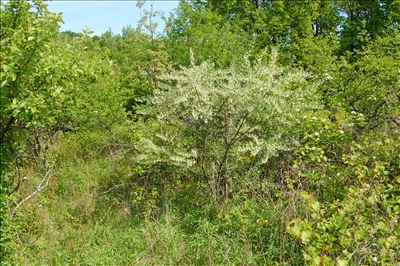
These are similar small trees with long silvery leaves. In summer the scales fall off Autumn Olive, which becomes greener, while Russian Olive remains silvery.
Importation:
These small trees were valued as ornamentals due to their silver coloured leaves, tolerance of drought, and ability to fix nitrogen, which allows them to grow on poor soil. They were imported into North America from China and Japan the 1830s and recommended for for wildlife habitat, mine reclamation, and shelter belts.
Problem:
Autumn olive invades old fields, woodland edges, and other disturbed areas. It can form a dense shrub layer which displaces native species and closes open areas.
In Montana, Russian olives have crept to the river banks and invaded irrigation canals. One farmer reported that Russian olives are a water-sapping nuisance that have overtaken between 200 and 300 acres of grazing land along his mile or so of river frontage.
In places they’re so thick you can’t get through them.
Montana Farmer
When it’s time to bring the cattle up from winter pasture near the river, two-inch thorns cut horseflesh and human skin.”
Montana Farmer
Control:
The Southeast Exotic Pest Plant Council Invasive Plant Manual recommends the following control measures:
Mechanical Controls
- Cutting: Cut trees at ground level before seeds have a chance to form. Resprouts are common after treatment, requiring either an herbicidal control or repeated cutting of resprouts.
- Girdling: Using a hand-axe, make a cut through the bark well into the cambium layer, encircling the base of the tree, approximately 15 cm (6 in) above the ground. Be sure that the cut goes well into or below the cambium layer. The top will die but the tree may resprout.
- Hand Pulling: Remove young seedlings when the soil is loose after rain, being careful not to leave roots behind to resprout.
Herbicidal Controls
- Foliar Spray Method: Used in thickets where there is no other vegetation.
- Cut Stump Method: Used to kill individual trees or if valuable species would be killed by foliar spray.
Availability and alternatives:
Russian Olive plants are available from many North American nurseries, and seeds can also be bought over the Internet.
The Pennsylvania Department of Conservation and Natural Resources suggests as alternatives to autumn olive or Russian olive in revegetation and wildlife habitat plantings: sweet-fern (Comptonia peregrina), bayberry (Myrica pensylvanica), shining sumac (Rhus copallina), fragrant sumac (Rhus aromatica), staghorn sumac (Rhus typhina), black-haw (Viburnum prunifolium), shadbush (Amelanchier arborea, A. laevis), clammy locust (Robinia viscosa), redbud (Cercis canadensis), and New Jersey tea (Ceanothus americanus).
English Ivy
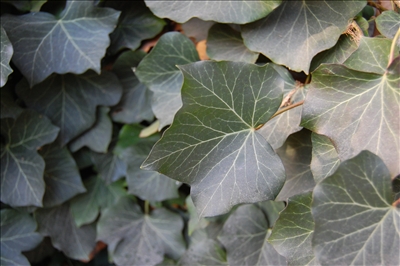
(Hedera helix)
ID:
English Ivy is a creeping ornamental evergreen ground cover. It has dark green leaves with white veins.
It is shade tolerant and spreads widely. Ivy can become arborescent and grow up to 50 metres (150 feet) up tree trunks.
Introduction:
Came to North America from Europe in early colonical times, and became widely planted as an ornamental.
Problem:
In an appropriate climate it can become invasive, creating an “Ivy Desert”, as it provides little in the way of cover or sustenance for native creatures. It can invade forests and force out native vegetation, and climb trees. By adding to the weight of trees it increases the chance of storm damage. It is especially a problem in the Pacific Northwest and in parts of British Columbia. It is considered invasive in AL, AZ, CA, GA, HI, IA, MD, NC, OR, PA, RI, TN, WI, and WV.
Control:
It can be removed manually but this takes a great deal of effort. In Stanley Park in Vancouver, B.C., the “Ivy Busters” estimate that in their first 39 “Ivy Pulls” more than 700 volunteers removed more than 20,000 square meters of ivy. They expect it will take 50 years of continuing effort to rid Stanley Park of this invasive pest. In Oregon the “No Ivy League” has organized over 205,900 volunteer hours over 15 years, and rescued 57,000+ trees from the “wretched grasp of English ivy”. They have removed over 267 acres (over 11.5 million square feet) of ground ivy from Forest Park and the surrounding areas.
The removed Ivy must be carefully disposed of in a landfill or incinerator to prevent it regrowing at a new location.
If herbicides are used, repeated applications are often necessary. The waxy leaves make it difficult for herbicides to work.
In some area blow torches have been used to burn ivy.
No biological controls are widely used for English ivy control. English ivy seems to have few pests in the United States
Availability:
Many types of English Ivy are widely available for sale at nurseries and garden centres across most parts of North America, and landscape companies continue to use it in commercail and residential projects.
Alternatives:
In Texas, native vines that are good replacements for English ivy include trumpet creeper (Campsis radicans), Virginia creeper (Parthenocissus quinquefolia), passionflower vine (Passiflora lutea), Dutchman’s pipe (Aristolochia macrophylla), and native wisteria (Wisteria frutescens).
In more northern climates, consider Parthenocissus quinquefolia (Virginia creeper) or Arctostaphylos uva-ursi (kinnikinnick).
Links to Invasive Species Resources
- The Ontario Invasive Plant Council
- Ontario Phragmites Working Group
- North American Invasive Species Network
- The Grow Me Instead Guides: Beautiful Non-Invasive Plants for your Garden
- How to report an invasive species sighting – Canadian list
- Canadian Council on Invasive Species
- National Invasive Species Information Centre (USA)
- Centre for Invasive Species and Ecosystem Health
Favourite Wildflowers and Shrubs
Recent Initiatives


Volunteering
 NANPS is a volunteer-operated organization. Virtually everything we achieve is through the efforts of volunteers. The more assistance offered by our members, the more we can accomplish together. If you have some time to give...even just occasionally...you can help. Read More...
NANPS Seed Exchange
 The 2023 - 2024 Seedex list is available for viewing at Native Plant Seed Exchange!
The NANPS Seed Exchange is open to all members across the continent and relies on your participation. If you are not yet a member, you may join online now or include your membership form with your seed request....Read More
The 2023 - 2024 Seedex list is available for viewing at Native Plant Seed Exchange!
The NANPS Seed Exchange is open to all members across the continent and relies on your participation. If you are not yet a member, you may join online now or include your membership form with your seed request....Read More